
Widya Robotics
Turning Behavioral Data into an Implemented AI Product Redesign
Using behavioral evidence to redesign Notulensi.id and Transkripsi.id across desktop and mobile.
More than 10 usability issues informed 108 implemented screens and more than 20 documented reusable components.
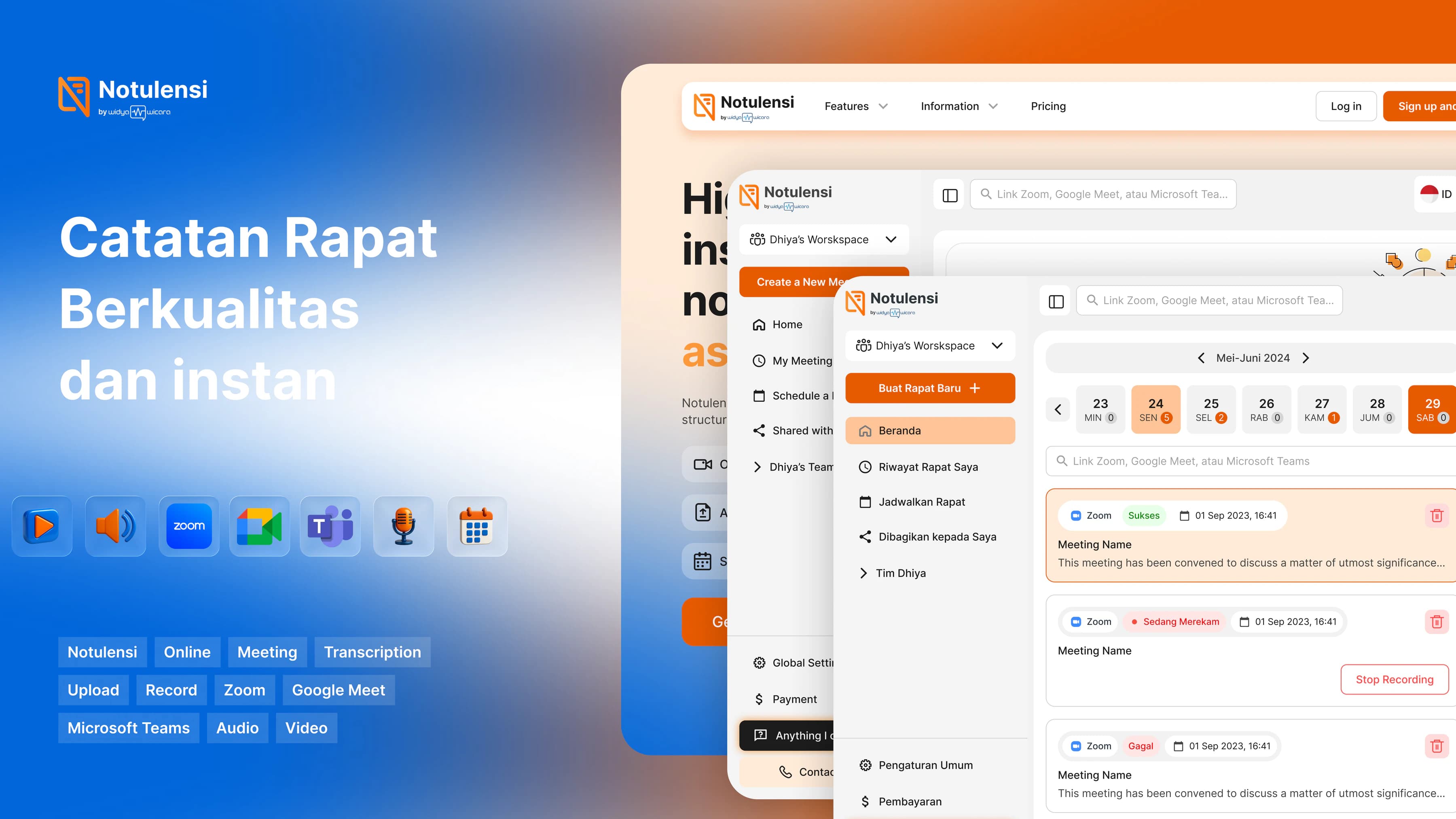
- Organization
- PT Widya Inovasi Indonesia / Widya Robotics
- Role
- UI/UX Intern
- Timeline
- August 2025–December 2025
- Status
- All assigned designs implemented
- Contribution
- Worked with one UI/UX staff member, two full-stack developers, and the CTO across Notulensi.id and Transkripsi.id.
- 01More than 10 usability issues identified
- 02108 desktop and mobile screens
- 03All assigned designs implemented
Project context
Redesigning two AI products through behavioral evidence
From August to December 2025, the work covered Notulensi.id and Transkripsi.id. Both products formed the scope of an evidence-led redesign across desktop and mobile.
The assigned output included navigation, banners, action feedback, loading states, icons, and illustrations, as well as broader product flows.
My role and collaboration
Contributing design inside a compact product team
I worked as a UI/UX Intern alongside one UI/UX staff member, two full-stack developers, and the CTO.
This collaboration connected behavioral analysis and interface design with the people responsible for product direction and implementation.
Problem
Product behavior pointed to usability issues that needed prioritization
PostHog behavioral data was used to identify more than 10 usability issues across Notulensi.id and Transkripsi.id.
The design challenge was to translate those signals into a manageable redesign scope rather than treating each observation as an isolated screen change.
Research and evidence
Turning behavioral analysis into an issue inventory
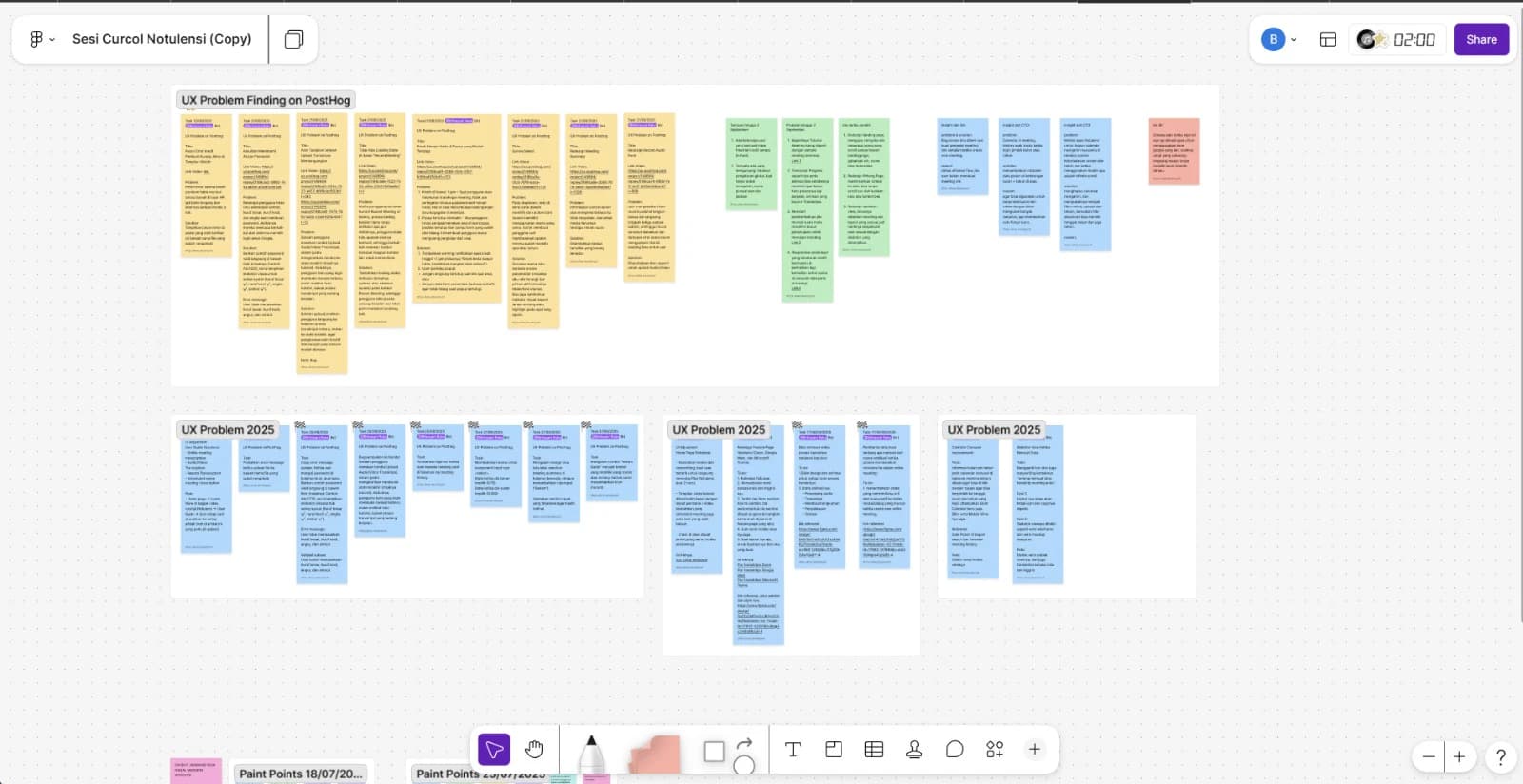
From evidence to scope
Turning behavioral signals into prioritized redesign work
- 01
Analyze behavior
Use PostHog evidence to review how the products were being used.
- 02
Identify issues
Document more than 10 usability issues across the product experience.
- 03
Prioritize tasks
Translate the findings into 16 redesign tasks.
- 04
Define flows
Develop one to three flows within each assigned redesign task.
Key design areas
Improving clarity across actions, states, and product structure
Navigation
Redesign work included navigation across the product experience.
Banners
Banners were included within the assigned redesign scope.
Action feedback
Feedback states clarified the response to user actions.
Loading states
Loading states supported AI processes that require waiting time.
Icons
Icons were designed as part of the interface work.
Illustrations
Illustrations supported the redesigned product experience.
Design exploration and decisions
Comparing dashboard and history redesign decisions
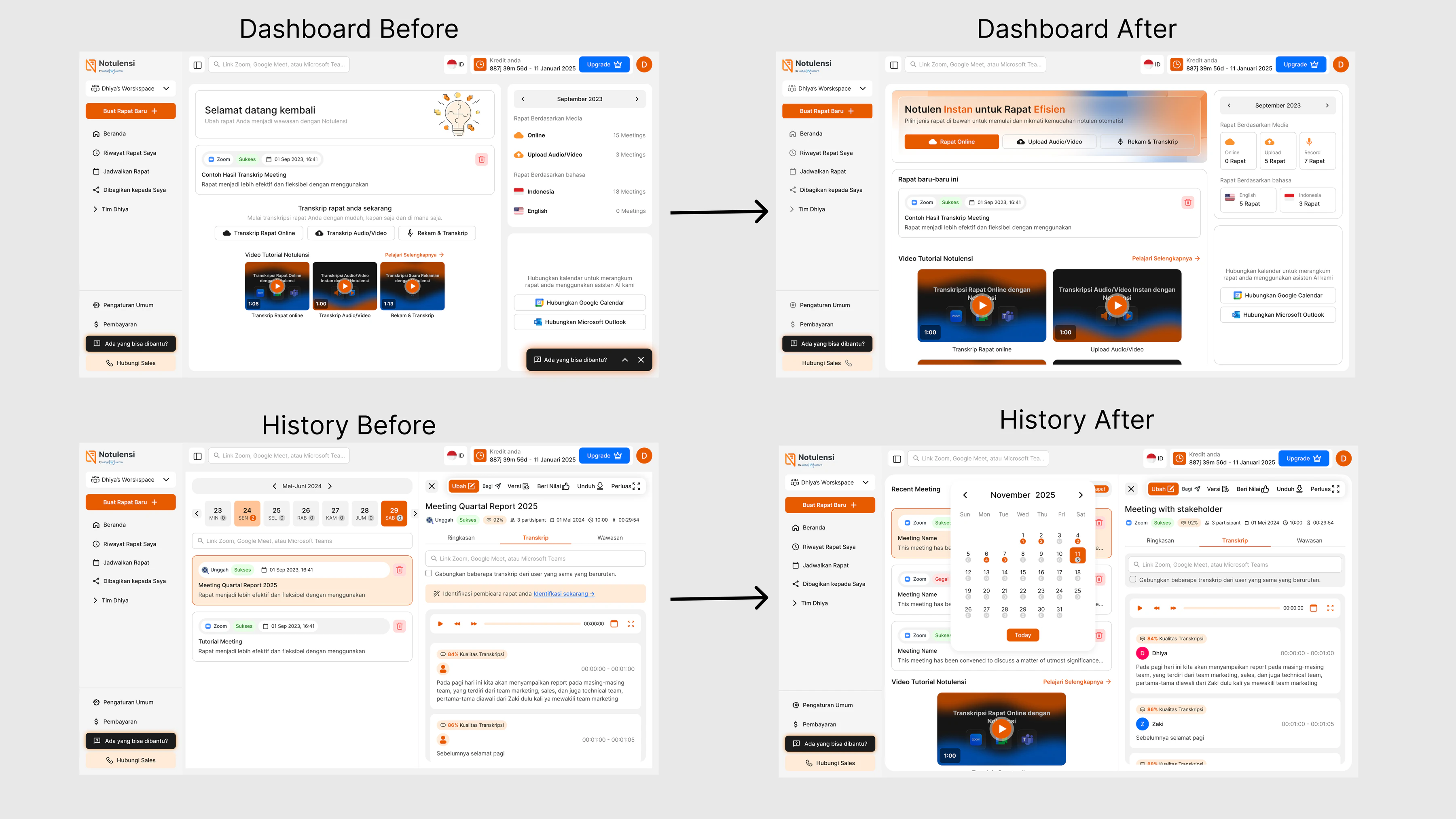
Feedback for AI processes
Designing states for work that is not instantaneous
The redesign scope included action feedback and loading states. These states were especially relevant to AI processes that require users to wait for a result.
The work also included icons, illustrations, and Rive animations to support product feedback and visual communication.
Design system
Documenting more than 20 reusable components
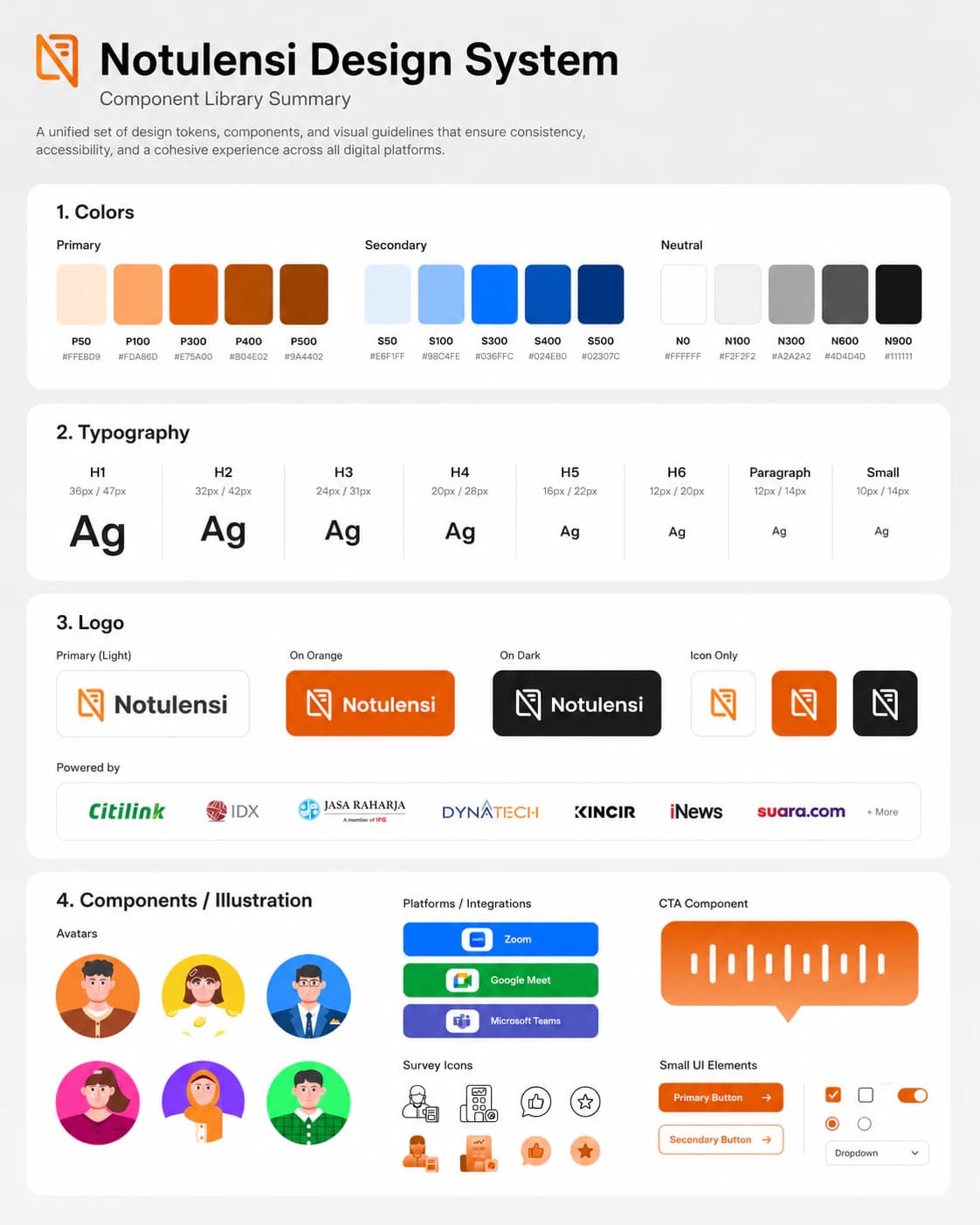
Motion and interface feedback
Rive animations within the product experience





Validation boundary
Behavioral findings shaped the work; post-launch metrics are not claimed
The verified evidence for this case study is the PostHog analysis, the identified usability issues, the assigned redesign scope, and implementation status.
No verified conversion, task-completion, retention, or quantitative post-launch satisfaction result is available, so none is presented here.
Implementation and project status
All assigned designs progressed into implementation
The final delivery comprised 108 desktop and mobile screens. All assigned designs were implemented.
Qualitative outcome
Clearer and more consistent design delivery
Reflection
What this work reinforced
What I learned
Behavioral signals become useful design inputs when they are translated into explicit priorities. The PostHog analysis helped move more than 10 usability issues into a structured set of 16 redesign tasks rather than a disconnected list of observations. Designing feedback and loading states also reinforced the importance of communicating progress when AI processes require waiting time.
What I would do next
The more than 20 documented reusable components created a clearer bridge to implementation. Continuing to strengthen component documentation, state coverage, and handoff context would help developers apply the system consistently as the products evolve.